One vote decided whether a promise meant anything inside the castle. And whether friendship mattered more than survival.
In the final moments of the latest UK series of ‘The Traitors’, Stephen Libby faced a clean, brutal choice. Break his pact with fellow traitor Rachel Duffy, or write off the last faithful standing, Jack Butler, who had become his real friend. What happened next turned a three-week paranoia marathon into a loyalty story, with a cash receipt attached.
The last vote: friend out, pact intact
The BBC reports that the finale boiled down to three players at the final vote, with Libby ultimately voting out Butler. Libby told Duffy, “I couldn’t go back on my word to you,” sealing a two-traitor win and a split of the 95,750 prize. The full outcome and key moments were detailed in the BBC’s write-up of the finale, which includes spoilers and the on-camera quotes from the endgame players and host Claudia Winkleman.
It is the kind of ending the format is built to tempt people away from, the classic “turn on your partner at the finish line” move. Instead, Libby and Duffy took the less obvious route for traitors. They stayed paired, stayed undetected, and stayed paid.
The numbers that make execs lean in
The ending did not just land in group chats. It landed in the ratings.
According to the BBC, more than nine million people tuned in to the finale, making it the most-watched episode of the civilian version of the show. The overnight audience was reported to peak at 9.6m during the final moments, which the BBC noted was the UK’s biggest overnight audience since the ‘Celebrity Traitors’ final in November, which attracted an average audience of 11.1m.
For a reality competition built on slow-burn suspicion and long, circular arguments at a round table, that kind of reach is a power signal. It says the format is still converting casual viewers into “I have to see the ending live” viewers, even after multiple seasons have trained the audience on the tricks.
The Traitors winners set for showbiz career after nailbiting final https://t.co/AL8dzEI2oe pic.twitter.com/aL3FBlhV3C
— Standard Culture (@ESCulture) January 24, 2026
Claudia Winkleman’s line, and why it stuck
Host Claudia Winkleman has always played the show like a mischievous ringmaster, nudging everyone toward paranoia without breaking the spell. The BBC quoted her wrapping the finale with a tidy contradiction that doubles as the show’s thesis statement: “Two traitors, but totally faithful to each other.”
That line matters because it captures what the finale’s winners were selling all season. Not innocence, not kindness, not even calm. Just commitment, performed consistently enough that faithful players kept aiming at the wrong targets.
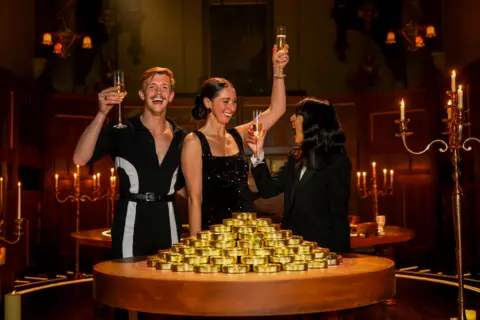
Rachel Duffy’s win has a milestone attached
Duffy did not just win. She won with a label attached to it.
The BBC reports she is the first female traitor to win the UK show. On screen, she framed it as both personal and symbolic: “It’s the best feeling in the world.” She added that she had seen it as an achievement to reach the final, then took it further by finishing the job. “I’m really looking forward to not having to lie,” she said, a line that lands differently depending on whether you watched her game as strategy, acting, or a stress test for friendships.
Duffy also offered a specific plan for the money that pulled the show back into real life. She said she would use the prize for a holiday and to make memories with her children and mother, who has dementia, telling the BBC: “When you know her memories are going and you have an opportunity to help her create the nicest ones ever, I think that’s very precious.”
That detail is part of why ‘The Traitors’ hits harder than standard competition TV. The castle is a game, but the prize is not. When winners name families, mortgages, and health realities, viewers recalibrate the entire season in hindsight.
🏆 #TheTraitors Winner!
The Traitors UK Series 4 champion: Rachel Duffy & Stephen Libby 🎉
Smart play, strong alliance, well-deserved win!
update news:https://t.co/eB79YGqezj#TraitorsUK #RealityTV pic.twitter.com/w8YfQl20IX— Janet D. Johnson (@LoveBoy892147) January 24, 2026
Stephen Libby: viral stress, steady endgame
Libby, a 32-year-old cyber security consultant from the Isle of Lewis, did not glide to the finish as the unbothered mastermind. The BBC notes he “regularly” went viral for his shocked expressions and sweaty, red-faced looks that showed how tense he felt, even while still making the right moves.
After the win, he framed it as an unlikely hometown moment: “I’m just a wee boy from the Isle of Lewis, this kind of stuff doesn’t happen to me,” he said, according to the BBC account of the finale.
In a season where many players try to look composed as proof of innocence, Libby’s stress became its own decoy. A man who looks like he is about to faint can be underestimated. Sometimes the “tell” is just the lighting and the pressure.
The twist factor: a secret traitor, then open warfare
Every season of ‘The Traitors’ has to answer the same question: how do you keep a familiar format feeling dangerous? This run leaned into structural tricks and interpersonal blowups.
The BBC says the season included the introduction of a “secret traitor,” whose identity was initially unknown to viewers and the other traitors. That player was revealed to be Fiona, who then turned on Duffy in “explosive scenes” inside the castle. The BBC reports that Duffy ultimately removed her from the game, and later navigated conflict when crime author Harriet launched a vocal attack as well.
That is the show’s tightrope. The mechanics are a formula, but the social chaos has to feel freshly combustible. Secret roles and late-game betrayal attempts are part of the producer toolkit. Whether fans love those twists or argue they warp fairness, they do one thing reliably: they create moments people feel they need to witness, not just catch up on later.
Why the ending will keep being debated
Libby’s final choice will split viewers into two camps that both have a point.
Camp one: the goal is to win money, and the cleanest path is to cut your partner before they cut you. If Libby had turned on Duffy, he might have maximized his odds and possibly his share.
Camp two: the game is not played in a vacuum. Duffy and Libby survived because they built an agreement and kept it. Breaking it at the last step could have introduced chaos, backlash, and misreads at the worst possible time. The “obvious betrayal” can be obvious enough that other players anticipate it, and the whole endgame collapses.
And there is the human factor the show quietly exploits. People form real bonds in pressured isolation. A finale decision is made with nerves, cameras, and reputations in play. A winner does not just cash a check. They leave with an identity attached.
What to watch next
The BBC says the series has been attracting more than 12 million viewers, and that kind of audience tends to invite two things: more seasons, and bigger swings to keep the machine fed.
Watch for how future UK seasons handle the “secret traitor” idea. A twist that hides information from both viewers and players changes the contract of the show. It can also change how fans argue about what “deserved” means.
And watch the winners’ next moves. The BBC playfully suggested Duffy could get an open-top bus parade through Newry, while Libby is positioned for a hero’s welcome in Stornoway. Whether those celebrations happen or not, the show has already done its job. It turned two ordinary lives into the kind of national conversation that ends with catchphrases, memes, and receipts.
In the end, the finale hinged on a sentence that is both romantic and ruthless. “I couldn’t go back on my word to you,” Libby said. In a game designed to reward lying, that was the final weapon.