

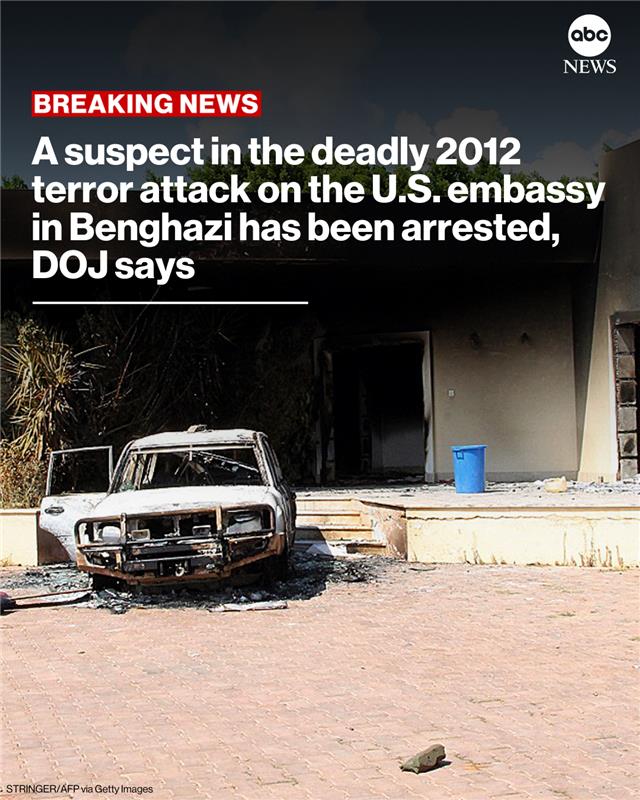
The Benghazi case never really goes away. It just goes quiet, then resurfaces when someone new ends up in custody, and the old arguments suddenly have fresh oxygen.
This time, the spark is an arrest.
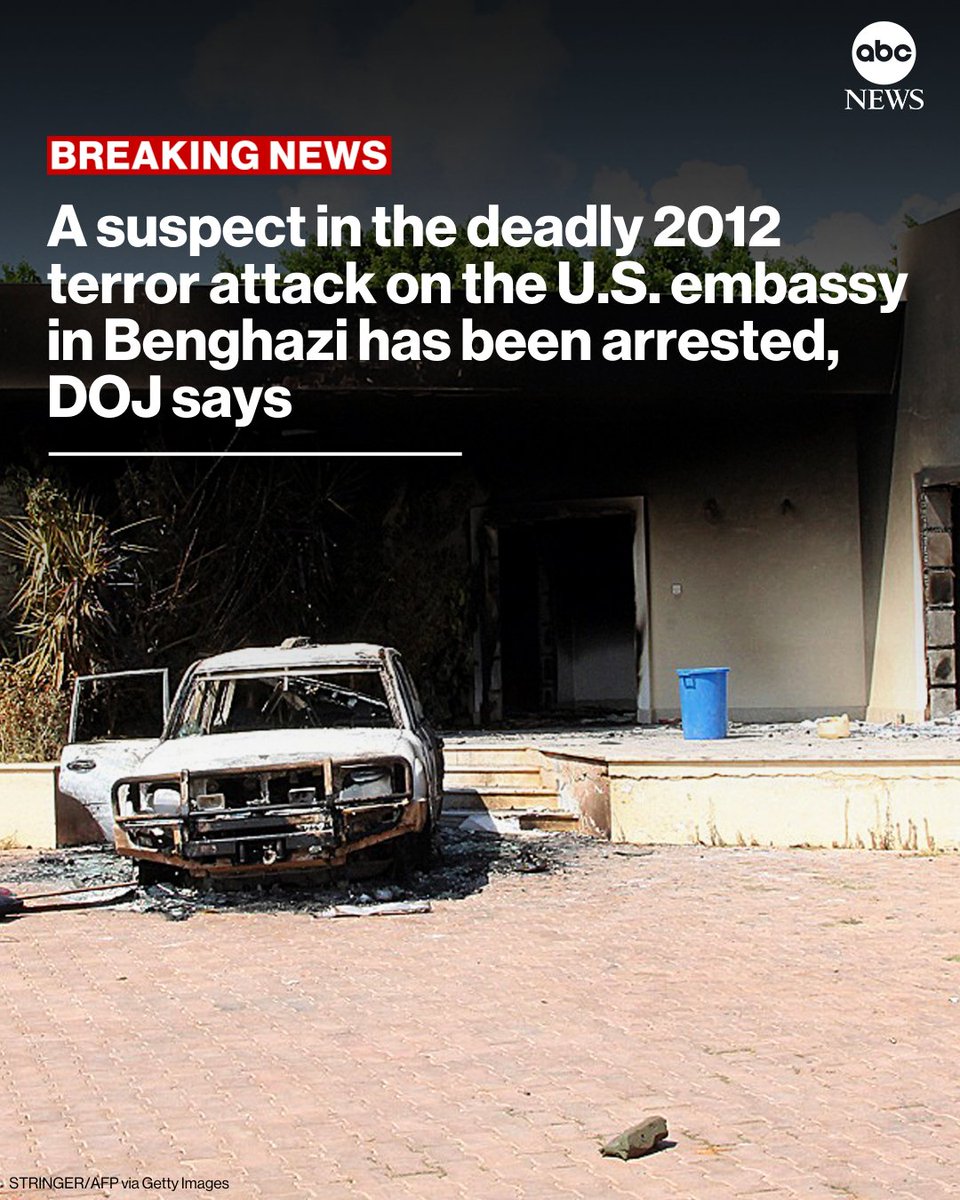
BREAKING: A suspect in the 2012 terrorist attack on the U.S. embassy in Benghazi, Libya, has been arrested and brought back to the U.S., Attorney General Pam Bondi said Friday.
Read more: https://t.co/7qksbwOcBT pic.twitter.com/W6ls29bZOc
— ABC News (@ABC) February 6, 2026
According to CBS News, the Justice Department says an alleged key participant in the September 11th, 2012, attack on U.S. facilities in Benghazi, Libya, was arrested and brought to the United States. That one development pulls a dozen dormant questions back into view, including what evidence prosecutors have, who else investigators still want, and whether the government can turn a faraway battlefield mess into a clean American courtroom narrative.
What DOJ Is Signaling With One Arrest
In the CBS News report, the framing is blunt and carefully chosen. The outlet describes the detainee as central to the attack, writing, “A suspect who was allegedly one of the key participants in the 2012 attack at a U.S. consulate in Benghazi, Libya, was arrested and brought to the U.S.”
That is not a conviction, and it is not even an indictment in the public record, at least not in the CBS segment itself. However, it is a clear signal that the government wants the public to understand this as more than a routine terrorism case.
When DOJ moves someone from overseas into U.S. custody, it often means prosecutors believe they can do three things at once:
- Present a story to a jury that survives cross-examination.
- Protect intelligence equities while still disclosing evidence under U.S. criminal rules.
- Demonstrate reach, meaning the U.S. can still find and seize suspects years later.
All of that is hard in a case like Benghazi, where the original crime scene was chaotic, the security environment was unstable, and much of the earliest information was fragmented, disputed, or politically weaponized.
The Facts That Never Changed, Even as the Politics Did
Strip away the decade of cable-news trench warfare, and there are basic facts that remain fixed. The September 11th, 2012, attacks in Benghazi killed four Americans, including U.S. Ambassador Christopher Stevens.
The U.S. State Department’s Accountability Review Board report, released in December 2012, laid out a withering assessment of security shortcomings and management failures. It also did something that still shapes how Benghazi is argued and litigated, in public: it framed the episode as a preventable breakdown without pinning criminal blame on a single U.S. official.
That distinction matters because Benghazi has always lived in two worlds at once. In one world, it is a counterterrorism case with suspects, charges, evidence, and trials. In the other, it is a political symbol, used to imply larger narratives about competence, honesty, and accountability.
A fresh arrest forces those worlds to collide again.
A suspect in the 2012 terrorist attack on the U.S. embassy in Benghazi has been arrested and brought back to the United States. https://t.co/M9PMCacPT2 pic.twitter.com/lTdTik9bbB
— ABC 7 Chicago (@ABC7Chicago) February 6, 2026
Why This One Defendant Could Matter More Than His Name
The public tends to treat terrorism prosecutions as a scoreboard. Someone is captured, someone is sentenced, case closed. Benghazi never fit that model.
Years after the attack, the U.S. did prosecute at least one major defendant. In a Justice Department announcement about Ahmed Abu Khattala, the DOJ said he was sentenced to 22 years in prison for his role in the Benghazi attacks. That case showed prosecutors could, in fact, take an overseas suspect and run a full federal prosecution to a verdict and a long sentence.
However, it also highlighted the limits of what a single trial can resolve. A criminal case answers specific questions, including what one defendant did, which charges fit, and what evidence can be proven beyond a reasonable doubt. It does not automatically answer the wider public questions that have surrounded Benghazi for years, including who planned what, who gave orders, and what U.S. agencies knew in real time.
That is where a new alleged “key participant” could change the story. Not because the public needs another name, but because a new defendant can bring new evidence into the record.
If prosecutors believe this suspect is a true insider, the stakes are bigger than one trial. A cooperative defendant can help map networks, identify additional suspects, corroborate intelligence, and fill in timelines.
An uncooperative defendant can still force the government to show its hand, at least partially, in open court.
The Contradiction That Still Haunts Benghazi
Benghazi is infamous because it sits at the intersection of two kinds of failure that Americans do not like to see at the same time.
- Security and intelligence failure, meaning a U.S. facility was hit, Americans died, and warnings and protections were not enough.
- Narrative and credibility failure, meaning the public argument over what happened became a fight over what officials said, when they said it, and what they appeared to be protecting.
Those failures are related, but they are not identical. The Accountability Review Board focused on systemic security issues and internal decision-making. Political actors, over many years, focused on public messaging and who should pay a career price.
A new DOJ case does not resolve that contradiction. In fact, it can sharpen it.
If prosecutors come in with a narrow case, focused on one person, critics will argue it is too small for a tragedy this big. If prosecutors come in with expansive claims, critics will demand to know why those claims took so long to produce in court, and whether the timing has anything to do with the political calendar.
The government has to walk a tightrope it helped create.
What to Watch Next in Court, Not on TV
If DOJ has, in fact, brought a Benghazi suspect into the United States, the most revealing moments often come early, and they are procedural, not dramatic.
Here is what tends to matter:
- Where the case is filed, because venue can hint at investigative history, and which offices have been running the work.
- What the charging document alleges, because language like “conspired” and “material support” signals scope.
- How much evidence is classified, because that affects speed, disclosure fights, and what can be aired in public.
- Whether prosecutors talk about additional defendants, because that can indicate whether this is a standalone case or a wider push.
There is also the human factor. A defendant who believes he is one of many and has been left holding the bag can become a source of information. A defendant who believes he is a symbol and wants to perform for supporters can become a courtroom headache. Either way, DOJ is making a bet that the federal system can absorb the case without turning it into a spectacle.
Accountability, at the Speed of Bureaucracy
Benghazi has always been a test of what accountability looks like in the real world, where agencies move slowly, evidence is messy, and politics is loud.
The Accountability Review Board report made clear that the State Department saw deep structural problems in security posture and decision-making. The Khattala case made clear that the DOJ could still put a defendant in a U.S. courtroom and win a serious sentence.
This new arrest, as described by CBS News, raises a different question: whether the U.S. is still building toward a fuller accounting of the attack, or whether it is taking the cases it can get, when it can get them.
Either answer has consequences. A fuller accounting would likely require more arrests, more intelligence disclosures, and more pressure on any government, group, or militia tied to suspects. A narrower strategy might limit exposure, but it risks leaving the public with the same unsettled feeling that has defined Benghazi for more than a decade.
For now, one fact is doing all the work. DOJ says it has someone in custody. The rest will depend on what prosecutors can prove, what they are willing to reveal, and whether the next chapter finally adds new information, or just replays the old fight with a new defendant in the frame.
References