The post was up long enough to get noticed. Then it was gone. What stayed behind was the kind of explanation that sounds simple, but plays messy in public.
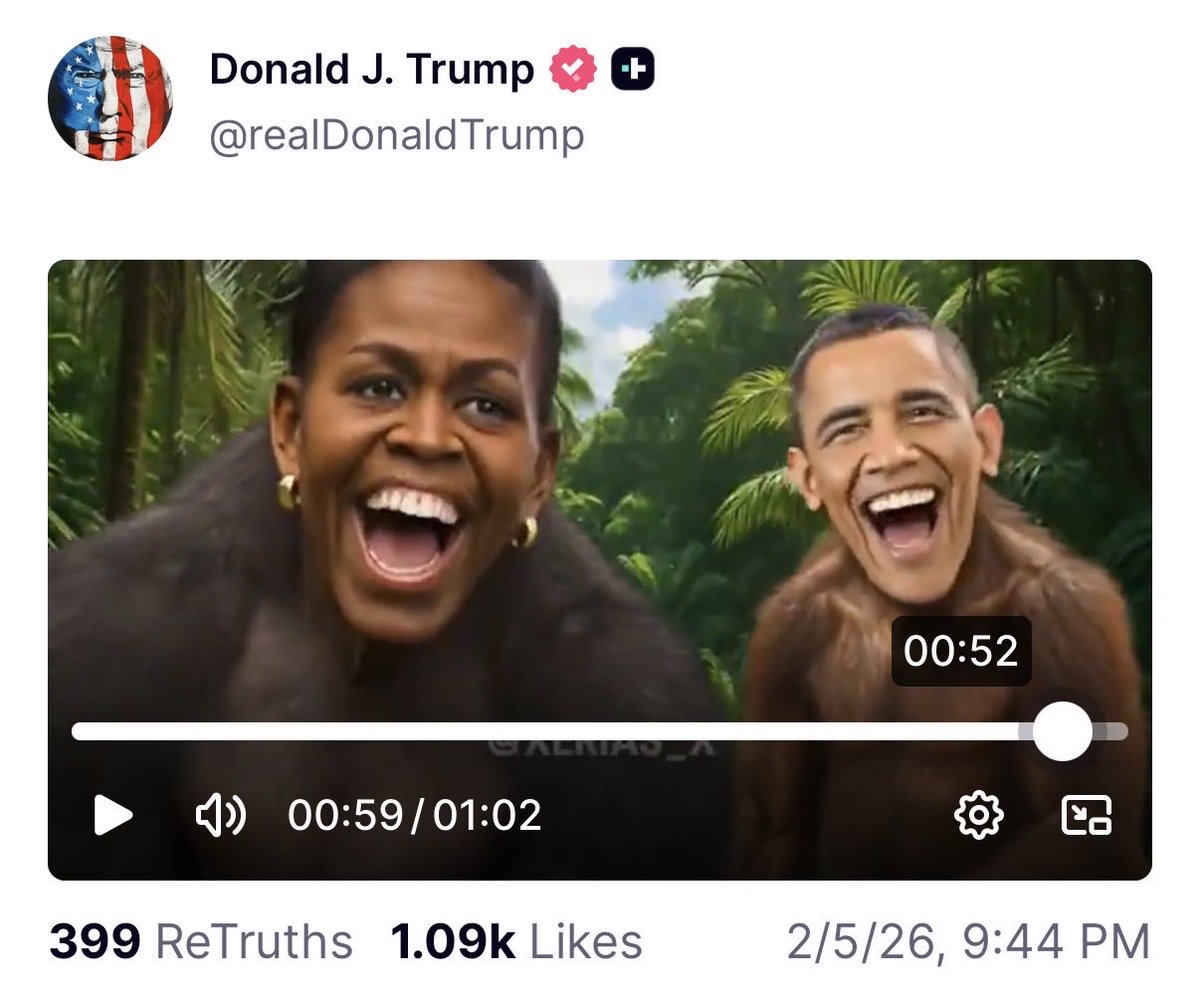
According to CBS News, a racist video shared on Donald Trump’s Truth Social account, one that depicted former President Barack Obama and former First Lady Michelle Obama as apes, was taken down. The outlet also reported an official line about how it happened, saying a staffer “erroneously made the post.”
NEW – In response to removed video of Obamas on ape bodies, posted on @POTUS‘ Truth Social – A White House Official tells Spectrum News:
“A White House staffer erroneously made the post. It has been taken down…”@SpectrumNewsDC
MORE: https://t.co/uHCJ1Ky32D pic.twitter.com/LM80jvGcrg
— Evan Koslof (@ekoslof) February 6, 2026
That one sentence does two things at once. It acknowledges the content existed, and it tries to separate the candidate from the act. The catch is that the post appeared on an account that functions as Trump’s primary broadcast channel, the place where attacks, endorsements, and policy claims often land first.
The Power Question Behind a Simple Explanation
Blaming a staffer is a familiar move in modern politics, especially when social media turns a campaign into a 24-hour live wire. However, the Trump brand has long sold itself as the opposite of that. The pitch is directness, personal ownership, and a leader who says what he means and means what he says.
So, when an account that carries his name shares racially dehumanizing content, the staffer explanation does not only address the offensive material. It also quietly introduces another storyline: control.
If a staffer can post something like that without review, opponents can argue the operation is sloppy. If a staffer did not, and the campaign is still floating that line, critics can argue the operation is evasive. Either way, the same question hangs over it: Who is accountable for what gets amplified to millions of followers?
Why This Hits Harder Than a Typical Social Media Flare-Up
This was not a typo, a clipped video lacking context, or a meme that can be brushed off as crude. Depicting Black people as apes is a racist trope with a long history, and its meaning is not subtle. That is why the removal does not automatically end the story.
In political terms, the stakes are not limited to one ugly post. They ripple into coalition politics, donor comfort, and turnout math.
Trump has tried to make the 2024 election a referendum on inflation, immigration, and President Biden’s competence. Moments like this yank the spotlight back to character, race, and grievance politics. Even if that is not where Trump wants the argument to be, it is where the argument can end up, because controversies like this are easy to summarize and hard to defend.
The Timeline Matters, Even When the Post Disappears
CBS News described the post as having been taken down after it was shared to Trump’s Truth Social. The delete button changes the optics, but it does not erase the sequence.
First, the content is published. Second, it is seen, or at least detected, by people outside the campaign. Third, it is removed. Fourth, an explanation is offered that frames the post as a mistake.
That order is important because it implies reaction, not prevention. Campaigns that prioritize brand safety usually build layers of review to stop a post before it ever goes live. Campaigns that run hot and fast often clean up later.
Deletion can be framed as responsiveness. It can also be framed as damage control, depending on what else the campaign says, and what it chooses not to say.
What the Campaign Risks by Treating It as a Staff Error
The staffer defense can protect the principal in the short term, but it comes with a long-term cost. It invites deeper scrutiny into who has access, what the approval process looks like, and whether the candidate is hands-on or hands-off with the most incendiary parts of his online presence.
It also sets a standard that can boomerang later. If the explanation for a racially charged post is that an employee made an error, then the next time controversial content appears, reporters and political opponents can point back to this moment and ask whether the campaign fixed the problem or simply moved on.
In a tight election environment, campaigns want to control the agenda. They want to pick the battleground. Racially dehumanizing content is a battleground they do not get to manage once it is public.
Two Competing Realities, One Account
There is a contradiction at the center of the Trump social media machine. The account is treated as an extension of Trump’s voice, especially when it is used to attack rivals or to signal priorities. At the same time, when a post becomes toxic, the account can be treated like a corporate feed run by staff, where mistakes happen, and blame can be diffused.
That contradiction is not unique to Trump, but it is sharper in his case because his political persona is built on personal authorship. His supporters often credit him for bypassing filters. His critics often accuse him of using platforms to provoke and polarize. Both sides, in different ways, assume the posts reflect the man.
When the campaign leans on a staffer error, it tries to shift that assumption. It is a move that may satisfy some supporters, but it also gives skeptics a fresh line of attack: either the candidate is not in control of his message, or the campaign is asking the public to accept a convenient story without further detail.
What to Watch Next
There are two practical questions that will determine whether this becomes a one-day blaze or a longer-burning headache.
First, does the campaign offer more specificity? Naming a staffer is unlikely, but campaigns sometimes clarify internal processes, review protocols, or access controls when a controversy threatens to define them.
Second, does the candidate address it directly? Silence can keep an issue from growing, but it can also create a vacuum that others fill, especially when the content involves race and a former president.
CBS News reported the post was taken down. That is the easy part. The harder part is what follows when a campaign that sells strength and command is forced to explain why its loudest microphone broadcast something it now wants to disown.