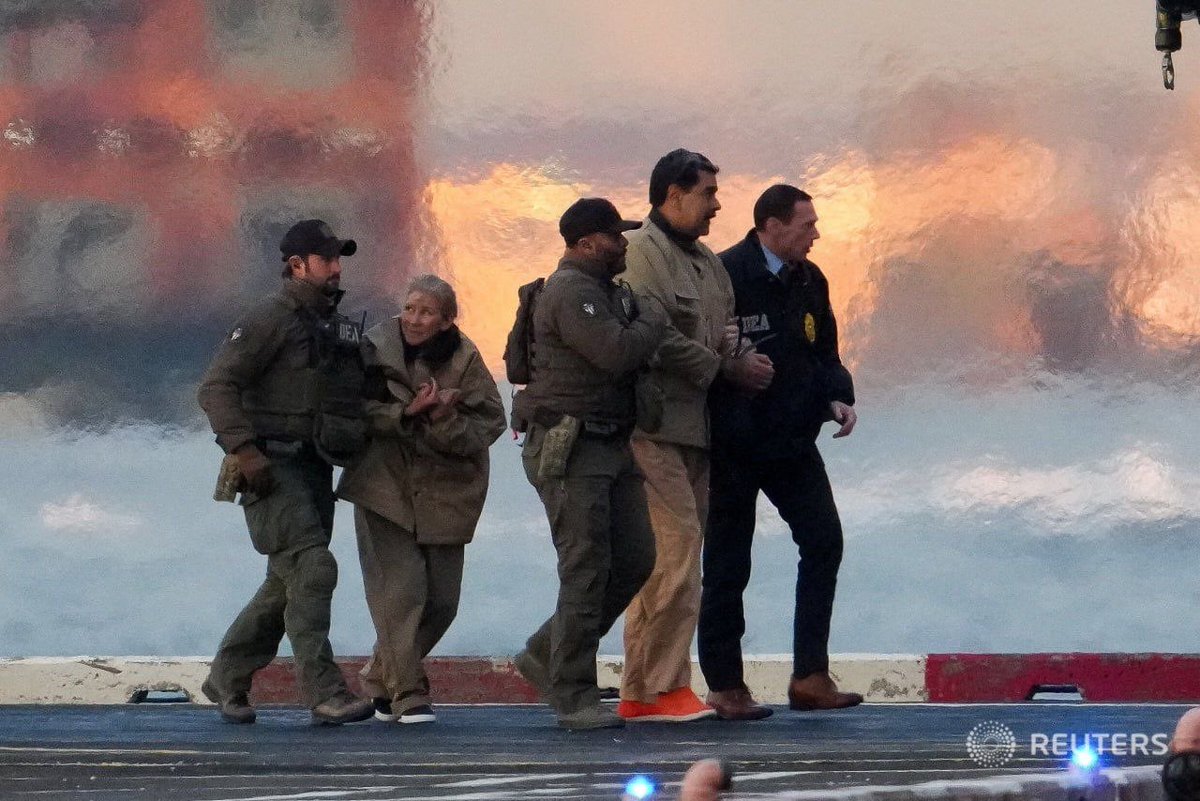
President Donald Trump did not just announce a major foreign-policy move tied to Venezuela. He reached back 200 years for the argument, and then gave it a nickname that instantly set off alarms and applause in equal measure.
In the wake of U.S. military action that the administration says led to the arrest of Venezuelan leader Nicolás Maduro, Trump pointed to the Monroe Doctrine, the 1823 warning to Europe to stay out of the Western Hemisphere. The result is a collision of slogans and stakes: America First politics on one side, and a doctrine historically used to justify intervention on the other.
Why Trump reached for a 19th-century doctrine in a 21st-century operation
Trump framed the operation and Maduro’s arrest as part of a hemispheric security campaign, leaning on the Monroe Doctrine’s basic idea that outside powers should not gain a foothold in the Americas. In remarks described by the Associated Press and published by PBS News, he even quipped that some people now call it the Don-roe Doctrine.
US President Donald Trump has invoked the 200-year-old Monroe Doctrine to justify a military operation in Venezuela, leading to the capture of President Nicolás Maduro and his wife. Rebranded by Trump as the “Donroe Doctrine,” the move signals a shift from deterrence to direct… pic.twitter.com/5bJcNBTsfO
— BS Blueprint (@BSBlueprint) January 6, 2026
It was a flash of humor with a serious subtext. The Trump White House has argued that Venezuela under Maduro had been increasingly hosting foreign adversaries in our region and acquiring menacing offensive weapons that could threaten U.S. interests, according to the same report.
Trump also cast the move in energy and stability terms, saying: We want to surround ourselves with good neighbors, we want to surround ourselves with stability, and we want to surround ourselves with energy. We have tremendous energy in that country. It is very important that we protect it. We need that for ourselves. We need that for the world.
The contradiction that instantly became the story
In the administration’s telling, invoking the Monroe Doctrine is about protecting the U.S. from rivals and threats close to home. But critics, and even some potential supporters, see the trapdoor: the same rhetoric can open the door to deeper involvement, including open-ended commitments that look a lot like the forever wars Trump has repeatedly criticized.
The PBS News report says Trump asserted that Washington would run Venezuela until a suitable replacement for Maduro was in place. That claim, and the sheer scale of arresting a foreign leader to face U.S. criminal charges, is exactly why the Monroe Doctrine reference matters. It is not just history-class wallpaper. It is a legal and political story about how presidents justify power.
What the Monroe Doctrine actually said, and what it became
The Monroe Doctrine began as a warning to European powers. In President James Monroe’s 1823 message to Congress, the United States opposed European colonization and interference in the newly independent nations of the Western Hemisphere. In exchange, the U.S. signaled it would stay out of European wars and internal affairs.
But the part that echoes through today’s debates is what came next: the doctrine was repeatedly invoked by later presidents as a rationale for U.S. action in Latin America, including military intervention.
One early flashpoint came in the 1860s, after France installed Emperor Maximilian in Mexico. Following the U.S. Civil War, France ultimately withdrew under U.S. pressure.
Then came Theodore Roosevelt’s 1904 add-on, the Roosevelt Corollary, which argued the U.S. could intervene in unstable Latin American countries. Over time, that logic became tied to a broader era of Big Stick diplomacy, and it provided a justification that presidents could reuse, repackage, and expand.
During the Cold War, the Monroe Doctrine was also invoked as a defense against communism, including the U.S. demand in 1962 that Soviet missiles be removed from Cuba, and the Reagan administration’s opposition to Nicaragua’s leftist Sandinista government.
Why Venezuela keeps showing up in this history
Political scientists and historians cited in the PBS News report say Venezuela has repeatedly served as a kind of trigger point for Monroe Doctrine thinking.
Historically, Venezuela has been the pretext or the trigger for a lot of corollaries to the Monroe Doctrine, Jay Sexton, a history professor at the University of Missouri and author of a book on the doctrine, told the AP.
Sexton pointed to a long pattern stretching from late-19th-century disputes into modern politics. In his view, presidents have often found the doctrine useful because it can be stretched. It can mean keeping Europeans out, or it can mean the U.S. stepping in.
The pushback: a doctrine that can be used to police, not protect
Gretchen Murphy, a University of Texas professor and author who studies the doctrine’s cultural and political impact, argued Trump’s reference fits a familiar template. She said Roosevelt helped transform the doctrine from a shield against European interference into a rationale for intervention to police the region in line with U.S. interests.
Murphy put it even more bluntly in comments cited in the PBS News report: I think Trump is jumping on this familiar pattern, citing the Monroe Doctrine to legitimate interventions that undermine real democracy, and ones where various kinds of interests are served, including commercial interests.
That critique is not just academic. It goes straight to legitimacy. If the doctrine is used to frame U.S. actions as a regional rule rather than a specific response to a specific threat, it raises the question of limits. Who decides when intervention ends, and what counts as success?
The White House document that tried to make it official
The PBS News report notes that the administration’s national security strategy, released by the White House in December, references a Trump Corollary to the Monroe Doctrine. The stated goal is to restore American preeminence in the Western Hemisphere.
In that strategy, the administration also laid out military strikes on alleged drug trafficking boats in the Caribbean Sea and the eastern Pacific Ocean, framing them as part of this hemispheric posture. The document also emphasized narcotics, migration, and a reimagined U.S. military footprint in the region.
In other words, the Maduro arrest is not being sold as a one-off. It is being presented as a chapter in a larger doctrine-driven approach, one that ties security claims to power projection close to home.
The political risk: when doctrine meets the MAGA coalition
Sexton warned that the operation to capture Maduro, and any prolonged U.S. involvement in Venezuela, could split parts of Trump’s coalition. In the PBS News report, he compared the potential backlash to divisions that surfaced after U.S. strikes on Iran’s nuclear facilities.
The risk is structural: a coalition that includes vocal isolationists can unite around a swift show of strength, but fracture over occupation-like responsibilities, long timelines, or nation-building by another name.
That is also where Trump’s own rhetoric could become the tightest constraint. An administration that promises to avoid endless commitments may now have to define, in detail, what running Venezuela looks like, how long it lasts, and what happens if Venezuela’s leadership future remains uncertain, as PBS News put it.
What to watch next
Three questions will determine whether Trump’s Monroe Doctrine moment becomes a political win or a grinding headache.
First, the legal track: what criminal charges Maduro faces in U.S. court, and how the case proceeds, will shape global perceptions of whether this was primarily law enforcement, national security, or regime change framed as prosecution.
Second, the governance claim: if Washington insists it will effectively run Venezuela until a replacement is in place, Congress, allies, and critics will demand specifics, and timelines.
Third, the doctrine drift: the more the administration treats this as a reusable template for the hemisphere, the more it invites the oldest argument about the Monroe Doctrine. Is it a guardrail against rivals, or a blank check for intervention?
Trump made his pitch in the language of dominance, saying American dominance in the Western Hemisphere will never be questioned again. The question now is whether the doctrine he cited will keep the story contained, or keep expanding it.