Federal officials say there is a detail behind the fatal shooting of Renee Nicole Good in Minneapolis that changes how the public reads the split-second decision at the center of the case. It is not about politics. It is about what happened to the shooter six months earlier.
According to court records and statements cited by CBS News, the U.S. Immigration and Customs Enforcement officer who shot and killed Good, 37, during an immigration operation in Minneapolis is a veteran agent assigned to a high-risk tactical unit. He was also previously dragged by a car during an arrest attempt in Minnesota.
A Fatal Minneapolis Operation, and a Past Incident DHS Put on the Record
The ICE officer involved was assigned to Enforcement and Removal Operations, Special Response Team, often shortened to ERO SRT, CBS News reported. These teams are used for higher-risk operations, including executing arrest and search warrants and responding to barricaded situations.
DHS Secretary Kristi Noem told reporters the officer had been dragged by a car in an incident in June 2025, CBS News reported. Court records identify the officer as Jonathan Ross.
DHS has not publicly released details about the officer’s disciplinary history. CBS News reported it asked DHS about any discipline in the officer’s background.
The June 2025 Traffic Stop: Broken Window, Arm Inside, Dragged 100 Yards
The earlier incident is laid out in court records connected to a June 17, 2025 attempted arrest in Minnesota, CBS News reported. Federal immigration officers attempted to arrest Roberto Carlos Munoz, 39, on an immigration warrant in St. Paul, according to the report. CBS News also reported Munoz had previously been convicted of sexually assaulting a minor.
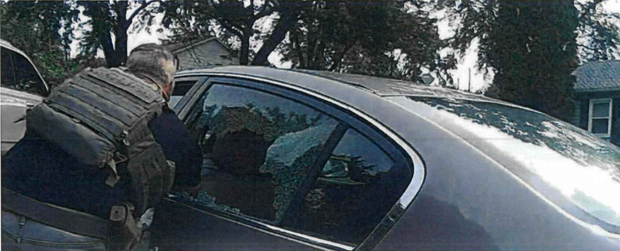
According to the court-record account cited by CBS News, agents tried to conduct a traffic stop and take Munoz into custody. He allegedly refused orders to roll down his windows or exit the vehicle. An ICE ERO officer broke a rear window and reached inside the car to unlock the door.
Then, the records say, Munoz allegedly put the vehicle in drive while the officer’s arm was still inside. The officer was dragged approximately 100 yards as the driver accelerated and weaved in an apparent effort to shake him off, CBS News reported.
The officer twice fired a Taser, unsuccessfully, according to the court-record narrative. The officer was ultimately freed when the vehicle knocked him out of the window and Munoz continued fleeing, CBS News reported. The officer suffered significant lacerations requiring 33 stitches. Munoz was later federally charged with assaulting a federal officer with a dangerous weapon, according to the report.
CBS News reported the ERO agent involved in that June incident was the same agent who later opened fire in the Minneapolis shooting.
Who Gets Put on an ICE Special Response Team, and Why It Matters Now
Special Response Teams are not routine patrol. CBS News described SRT work as high-risk operational support for immigration enforcement actions, including executing arrest and search warrants, transporting dangerous detainees, assisting with riot control or disturbances at detention facilities, and responding to barricaded subjects.
Members receive advanced training in tactical operations, firearms, defensive tactics and crowd control, CBS News reported. That context matters because it creates a sharp public question after a civilian death: how a trained tactical officer is supposed to approach moving vehicles, and what counts as avoidable danger versus unavoidable threat.
CBS News reported court records show Ross has been working with ICE in Minnesota since at least 2017, and that the agent has more than 10 years of experience.
The Use-Of-Force Line That Keeps Resurfacing: Shooting at a Moving Vehicle
Federal immigration enforcement has been under increased scrutiny in recent months, with advocates and attorneys accusing agents of operating with too little accountability. Those are accusations, not adjudicated findings, but they collide directly with a central rule in DHS policy: firearms are not supposed to be used simply to stop a moving vehicle.
Under DHS policy last updated in 2023, CBS News reported that firearms may not be discharged solely to disable a moving vehicle. Shooting at a moving vehicle is tightly restricted to two narrow circumstances, according to CBS News: when someone in the vehicle is using or imminently threatening deadly force by means other than the vehicle, or when the vehicle itself is being operated in a way that poses an imminent threat and no other objectively reasonable defensive option exists.
The policy explicitly includes an alternative that sounds simple on paper but can be hard in the moment: “moving out of the path of the vehicle,” the policy says, as quoted by CBS News.
That tactical expectation also showed up in a blunt assessment from a former senior Homeland Security Investigations agent quoted by CBS News. The former official said: “I’ve been conducting stops and approaches for 25 years I never ever wanted to be intentionally in front of the vehicle.”
The former agent’s point is not a verdict on the Minneapolis shooting. It is a window into how law enforcement training often frames these moments: avoid self-created jeopardy when feasible, create distance, and angle away from threats.
The Discipline Question, and a Chicago Case That Was About To Set Rules
Public trust fights often come down to one unglamorous question: what happens after the headlines. On discipline, CBS News reported that when it asked a Customs and Border Protection commander late last year whether any CBP or ICE agents had been disciplined as a result of recent immigration raids, he said none had been. CBS News also reported ICE’s head of training, Caleb Vitello, said in an interview he had not seen any uptick in discipline or investigations.
At the same time, a separate legal development is reshaping what restrictions apply in the field. CBS News reported that plaintiffs behind a landmark injunction in Chicago limiting immigration agents’ use of force are set to dismiss their lawsuit, even as federal officials signal renewed enforcement surges in major cities.
According to CBS News, that case had curbed chemical weapons and required body cameras and clear identification, but it is ending without a final ruling. The plaintiffs are dropping the suit not because concerns were resolved, CBS News reported, but because the 7th Circuit signaled it was likely to overturn the injunction, potentially creating a worse precedent.
In practical terms, CBS News reported, ICE and Border Patrol would no longer be legally bound by the injunction’s requirements around chemical agents, body cameras, or clear IDs. The government did not admit wrongdoing, according to the report.
Why Minneapolis Is the Pressure Point Right Now
The Minneapolis shooting is landing in a moment of expanded federal activity in Minnesota. CBS News reported that the Trump administration deployed about 2,000 federal immigration and investigative agents to the Minneapolis and St. Paul area as part of a crackdown tied to Minnesota’s fraud scandal and immigration enforcement.
More agents, more operations, and more high-risk teams can also mean more moments where policy language meets street-level chaos. For critics, the Renee Good case is a test of whether oversight mechanisms work when a fatal shooting involves a tactical officer with documented prior trauma in a vehicle-dragging incident. For officials, it is also a test of how to explain a use-of-force decision while an investigation unfolds and without prejudging outcomes.
What To Watch Next
Several threads are likely to define what happens next. One is the fact pattern, including what DHS and investigators say about the immediate circumstances that led to shots being fired in Minneapolis. Another is policy compliance, especially the DHS rules on shooting at moving vehicles and whether alternative defensive options existed in the moment.
And then there is the accountability piece, the question that keeps returning in ICE use-of-force controversies: whether any internal investigation results in discipline, retraining, or policy changes, or whether the public is again told that nothing changed.
For now, the most revealing detail may be the one DHS chose to disclose quickly. The officer who killed Renee Good, officials say, had recently lived through a stop where a car dragged him about 100 yards, and a former federal agent’s warning is now echoing back into the debate: “I never ever wanted to be intentionally in front of the vehicle.”