A woman is dead after an ICE officer opened fire in south Minneapolis, and the argument over what happened started almost immediately. Federal officials described the moment as “domestic terrorism.” City and state leaders pushed back, pointing to videos and witness accounts that they say do not match the federal framing.
Now the case sits at the center of a familiar American collision: federal enforcement power, street-level chaos, and a narrative war unfolding in public before investigators finish the first round of interviews.
The Basic Facts, and the Name at the Center
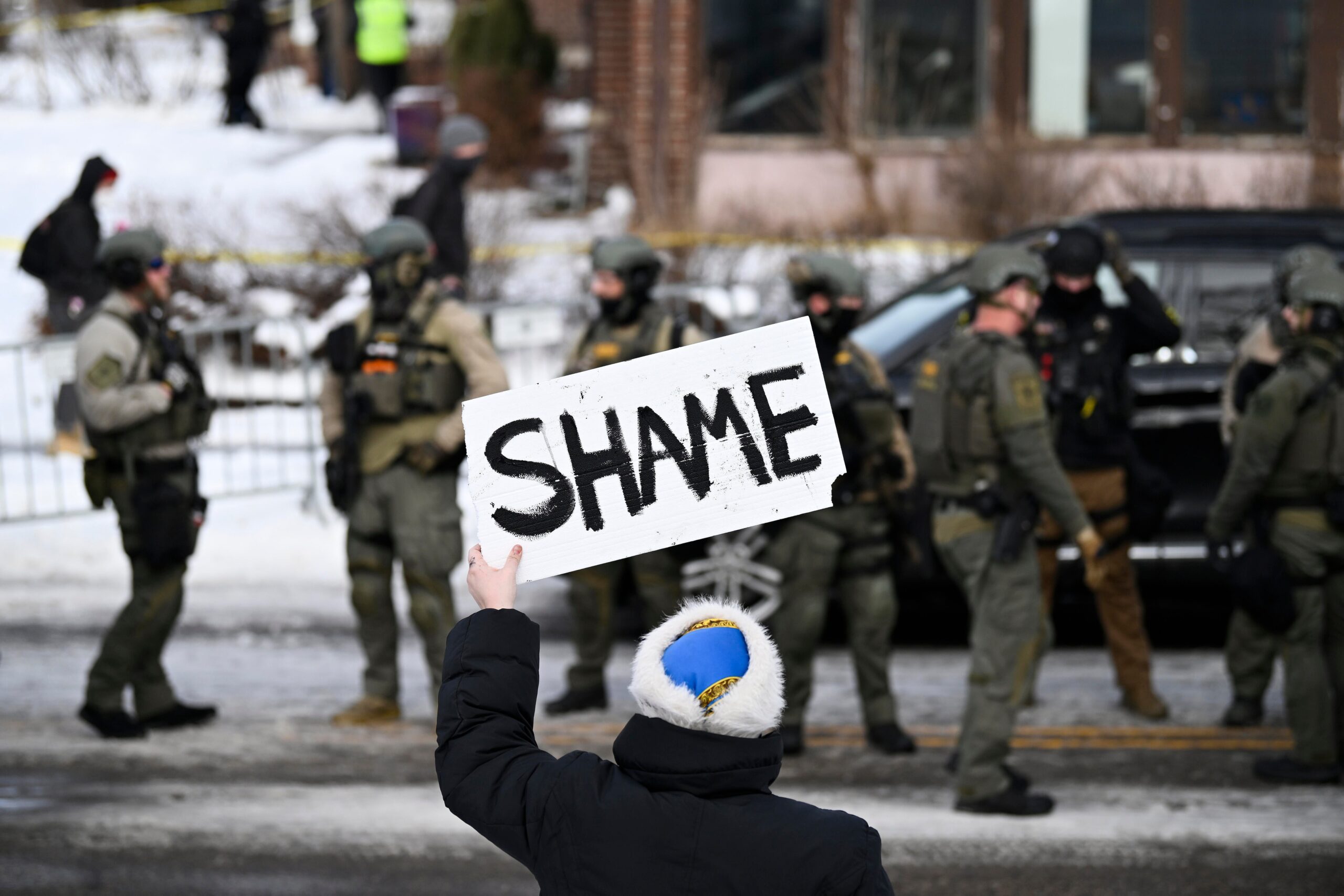
The Department of Homeland Security says an ICE officer fatally shot a woman Wednesday morning near East 34th Street and Portland Avenue in south Minneapolis. The area became a flashpoint as federal and local law enforcement clashed for hours with protesters.
A U.S. official identified the victim as 37-year-old Renee Good. According to two federal sources cited in reporting by CBS News, she was a U.S. citizen. City leaders said Good was a legal observer of federal actions in the city and was not a target for an ICE-related arrest.
Those details matter because they cut in opposite directions. Federal officials have described a threat to law enforcement. Local officials have described someone observing and documenting, not someone being pursued.
Witness Timeline: Whistles, a Blocked SUV, and 3 Shots
Witnesses told WCCO that whistles sounded to alert neighbors to ICE’s presence at about 9:30 a.m. They described a Honda Pilot blocked by multiple federal agents and said an agent tried to open the driver’s side door.
According to those witness accounts, the motorist put the vehicle into reverse and then into drive. Witnesses then reported hearing three shots. The Honda traveled several more feet before crashing into another vehicle.
CBS News also reported that videos posted to social media of the encounter corroborate witness accounts. Mayor Jacob Frey said he had seen the videos as well.
The Federal Narrative: ‘Act of Domestic Terrorism’
DHS Secretary Kristi Noem characterized the driver’s actions as an “act of domestic terrorism,” according to CBS News.
In a DHS statement cited in that reporting, Assistant Secretary for Public Affairs Tricia McLaughlin described the victim as “one of these violent rioters” who “weaponized her vehicle, attempting to run over our law enforcement officers in an attempt to kill them.” McLaughlin also labeled it “an act of domestic terrorism.”
That language sets a high-stakes frame. It implies a deliberate attempt to kill law enforcement officers and places the encounter inside the national security bucket, not simply a use-of-force incident during a protest response.
But it is also a claim that investigators can only ultimately support or reject based on evidence, including video, physical forensics, and witness statements. The FBI and Minnesota Bureau of Criminal Apprehension are investigating, according to CBS News.
The Local Pushback: Video, ‘Propaganda,’ and a Credibility Fight
Local leaders did not accept the DHS description at face value. Minnesota Gov. Tim Walz said, “Don’t believe this propaganda machine,” according to CBS News.
Frey also publicly disputed the federal narrative after viewing videos of the incident, CBS News reported. The mayor’s stance, combined with Walz’s comment, turned the story into more than a question of tactics. It became a direct credibility contest between federal leadership and local elected officials.
In practical terms, that credibility fight can shape everything from community cooperation with investigators to whether protests expand or cool down. In reputational terms, it forces both sides to stand behind their interpretations before the investigative agencies have issued findings.
One More Detail That Raised Eyebrows: the Officer’s Prior Incident
Noem said at a press conference Wednesday evening that the ICE officer who shot Good had been involved in an incident with an “anti-ICE rioter” in June, according to CBS News. The officer has not been publicly identified in the reporting provided.
Noem also said the officer was taken to a hospital after Wednesday’s shooting and has since been released.
By itself, prior involvement in an earlier incident does not prove misconduct. But it does signal why this case is likely to attract intense scrutiny. Any prior use-of-force related event can become a focal point for questions about training, supervision, and whether the agency identifies patterns early.
Why This Case Escalated So Fast
There are several reasons this story spread beyond Minneapolis quickly.
First, the victim’s reported status as a U.S. citizen, combined with city leaders describing her as a legal observer, pulled attention away from a simple enforcement operation. Legal observers are often associated with documenting police activity during protests, which heightens public interest in whether the shooting involved someone attempting to monitor the situation rather than participate in it.
Second, the “domestic terrorism” label is not a casual descriptor. It carries political, legal, and cultural weight. When senior federal officials use it immediately after a deadly encounter, it can be read as a warning to would-be protesters, a justification for the officer’s actions, or both.
Third, this happened amid hours-long clashes between law enforcement and protesters. That backdrop makes it harder to reconstruct the incident cleanly. Crowds move, commands can be hard to hear, and videos capture only fragments.
What Investigators Will Likely Focus On
The FBI and Minnesota BCA investigation will likely turn on a few concrete questions that are common in use-of-force cases involving vehicles.
Investigators typically look at distance and trajectory, the officer’s position relative to the vehicle, whether there was a clear path for the officer to move away, and whether the vehicle’s movement constituted an imminent threat at the moment shots were fired.
They also commonly examine chain-of-command decisions. Why was the vehicle blocked in the way witnesses described. What warnings were given, if any. What was the operational plan at that location. And how did federal and local agencies coordinate or fail to coordinate during the clash with protesters.
Video evidence, including social media footage referenced by CBS News, can be decisive, but only if investigators can authenticate timestamps, angles, and context. Short clips can also mislead if they begin after critical moments.
What To Watch Next
The next developments that typically matter most in a case like this are not rhetorical. They are procedural.
Watch for a formal public accounting of the investigative steps by the FBI or Minnesota BCA, including whether body-worn camera footage exists and whether it will be released. Watch for clarity on whether the officer’s weapon discharge followed agency policy and what policy was in effect at the time.
Also watch how DHS continues to describe Good. If federal officials maintain the “domestic terrorism” framing, they may face pressure to provide evidence that supports intent and imminent threat, not just danger created during a chaotic moment.
And watch how Minneapolis leaders define Good’s role as a “legal observer,” including what organization, if any, she was affiliated with and what documentation exists of that role.
A Fatal Encounter, and 2 Stories Fighting for the Same Facts
On one side is DHS, calling the incident “domestic terrorism” and describing an officer facing a vehicle used as a weapon. On the other are city and state leaders, citing videos and witness accounts and warning the public not to accept the federal version.
Between them is a single, irreversible fact: Renee Good, 37, is dead, and the FBI and Minnesota Bureau of Criminal Apprehension are now tasked with deciding which version of events fits the evidence, and which language was deployed too soon.
For now, the last clear line on the record is also the one that hints at how ugly the narrative fight could get before the investigation is done. “Don’t believe this propaganda machine,” Walz said.